Deepening Bilateral Trade Ties - The EU and Singapore further facilitate exports of Meat and Egg Products from the EU to Singapore
Singapore now accepts meat and eggs from 18 EU countries, even during disease outbreaks. New rules allow regionalised imports and flexible sourcing of raw materials to strengthen food security.
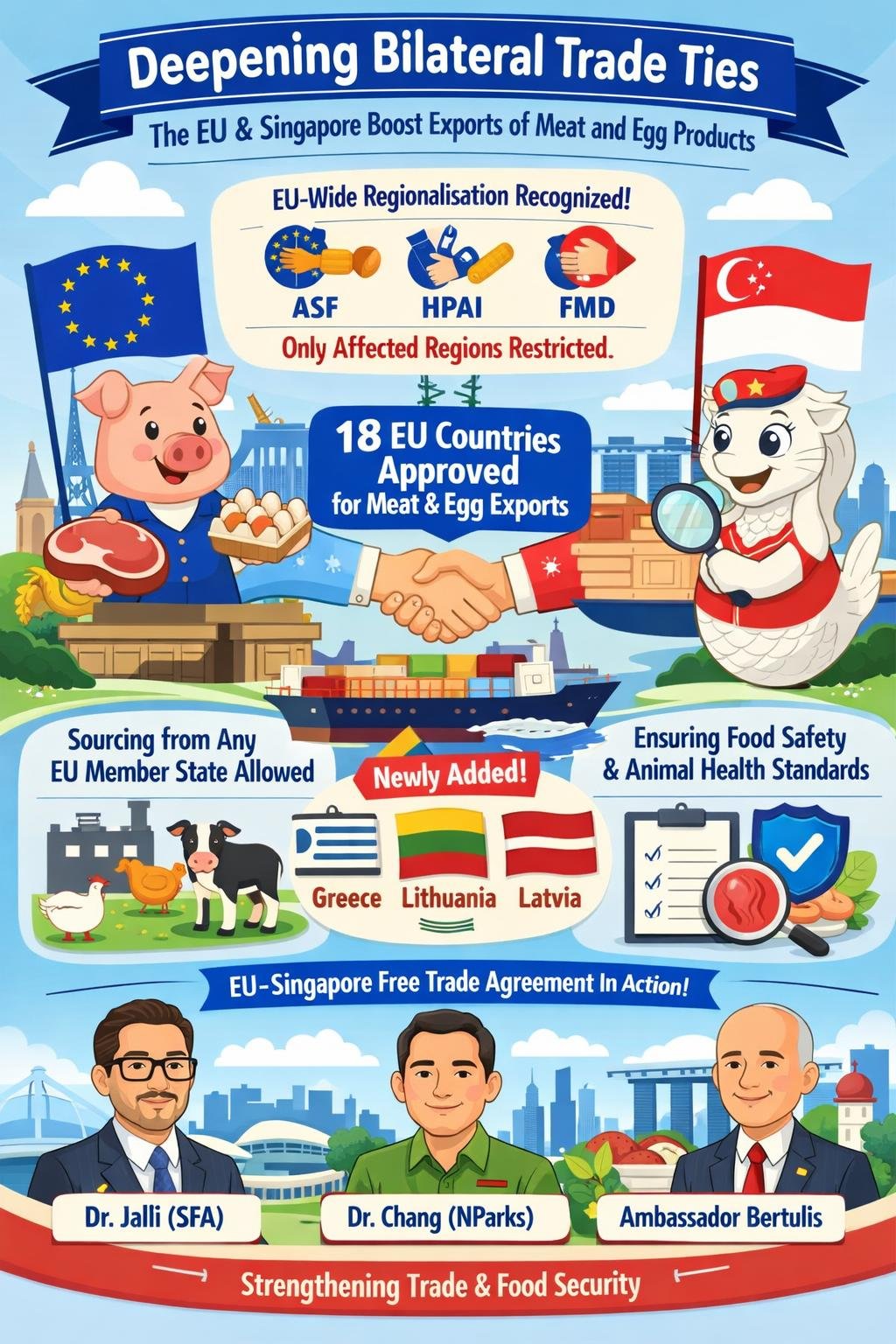
The European Union (EU) and Singapore have announced new measures to facilitate the export of meat and egg products from the EU to Singapore. The key change is that Singapore has now recognized EU-wide regionalisation measures for animal diseases, including African Swine Fever (ASF), Highly Pathogenic Avian Influenza (HPAI), and Foot-and-Mouth Disease (FMD). This means that if an outbreak occurs in one part of the EU, Singapore will apply restrictions only to the affected region rather than banning all imports from the entire country. The EU continues to guarantee high food safety standards for these exports.
In a further boost to trade, both sides agreed to allow raw materials used in manufacturing meat and egg products to be sourced from any EU member state approved by Singapore. This amends previous requirements that animals and their derived products must be born and raised in the same single EU Member State. This new arrangement facilitates intra-EU supply chains for meat, eggs, and their products destined for export to Singapore.
As part of ongoing reviews, Singapore has approved Greece, Lithuania, and Latvia as new import sources for meat, eggs, and their products. With these new approvals, a total of 18 EU Member States are now authorised to export meat and egg products to Singapore. The list of approved countries includes Austria, Belgium, Czechia, Denmark, Finland, France, Germany, Greece, Hungary, Ireland, Italy, Latvia, Lithuania, the Netherlands, Poland, Portugal, Spain, and Sweden.
These developments resulted from joint efforts between EU Member States and the European Commission in close collaboration with the Singapore Food Agency (SFA) and National Parks Board (NParks). The measures meet the highest standards for food safety and animal health.
The EU and Singapore agreed to continue working closely to facilitate trade in animal products. This is part of the implementation of the EU-Singapore Free Trade Agreement (EUSFTA), which has been in force since November 2019. The two sides have held five Committee meetings on Sanitary and Phytosanitary measures to discuss matters related to food safety and trade.
The trade facilitative measures and new country approvals will take effect once EU Member State Competent Authorities and the SFA have implemented the necessary administrative requirements.
Dr Abdul Jalil Abdul Kader, Director-General (Food Security) of SFA, stated that Singapore welcomes the collaboration with the European Union to implement EU-wide regionalisation and born-and-bred exemptions for meat and egg imports. This allows the continued export of food from unaffected areas in the EU during animal health outbreaks while maintaining food safety standards. He noted that this strengthens Singapore's efforts to diversify import sources against food supply disruptions, which is critical as Singapore imports 90% of its food supply.
Dr Chang Siow Foong, Director-General of the Animal & Veterinary Service within NParks, said that maintaining robust animal health protection goes hand in hand with ensuring food security and food safety standards. NParks is pleased to be part of this collaborative effort to assess and facilitate EU's proposals, thereby contributing towards Singapore's food resilience as well as trade partnership with the EU.
Artis Bertulis, European Union Ambassador to Singapore, stated that the recognition of the EU's comprehensive regulatory framework for food safety and animal health standards by Singapore is an important outcome to facilitate trade flows between the EU and Singapore. He noted that it demonstrates that the EU is a reliable partner for safe and secure trade in animal products, in line with international standards.
To deepen business partnerships in the agri-food sector, the EU will be the region of honour at Food and Hospitality Asia and ProWine 2026, taking place in Singapore from 21 to 24 April. This event will showcase the safety, quality, authenticity, and sustainability of EU food and beverages.
- Singapore now recognizes EU-wide regionalisation measures for animal diseases (ASF, HPAI, FMD), meaning imports are restricted only to affected regions during outbreaks rather than the whole country
- Raw materials for meat and egg products can now be sourced from any approved EU member state, removing the requirement that animals must be born and raised in the same single EU Member State
- Greece, Lithuania, and Latvia have been newly approved as import sources for meat, eggs, and their products
- A total of 18 EU Member States are now authorised to export meat and egg products to Singapore
- New measures take effect once EU Member State Competent Authorities and the SFA implement necessary administrative requirements
- EU will be region of honour at Food and Hospitality Asia and ProWine 2026 in Singapore from 21 to 24 April
Publisher: Singapore Food Agency
Editorial note: Ongoing trade facilitation and food safety updates remain relevant for consumers relying on imported food.