Inaugural Release of Report on Adoption of Artificial Intelligence Among Firms
MOM's first-ever report reveals AI adoption is still early in Singapore, with productivity gains seen but high costs and skills gaps holding back smaller firms.
The Ministry of Manpower (MOM) has released its first-ever report on how Singapore firms are adopting Artificial Intelligence (AI). Published on 30 April 2026 by the Manpower Research and Statistics Department, the findings show that AI adoption is still in its early stages across the economy.
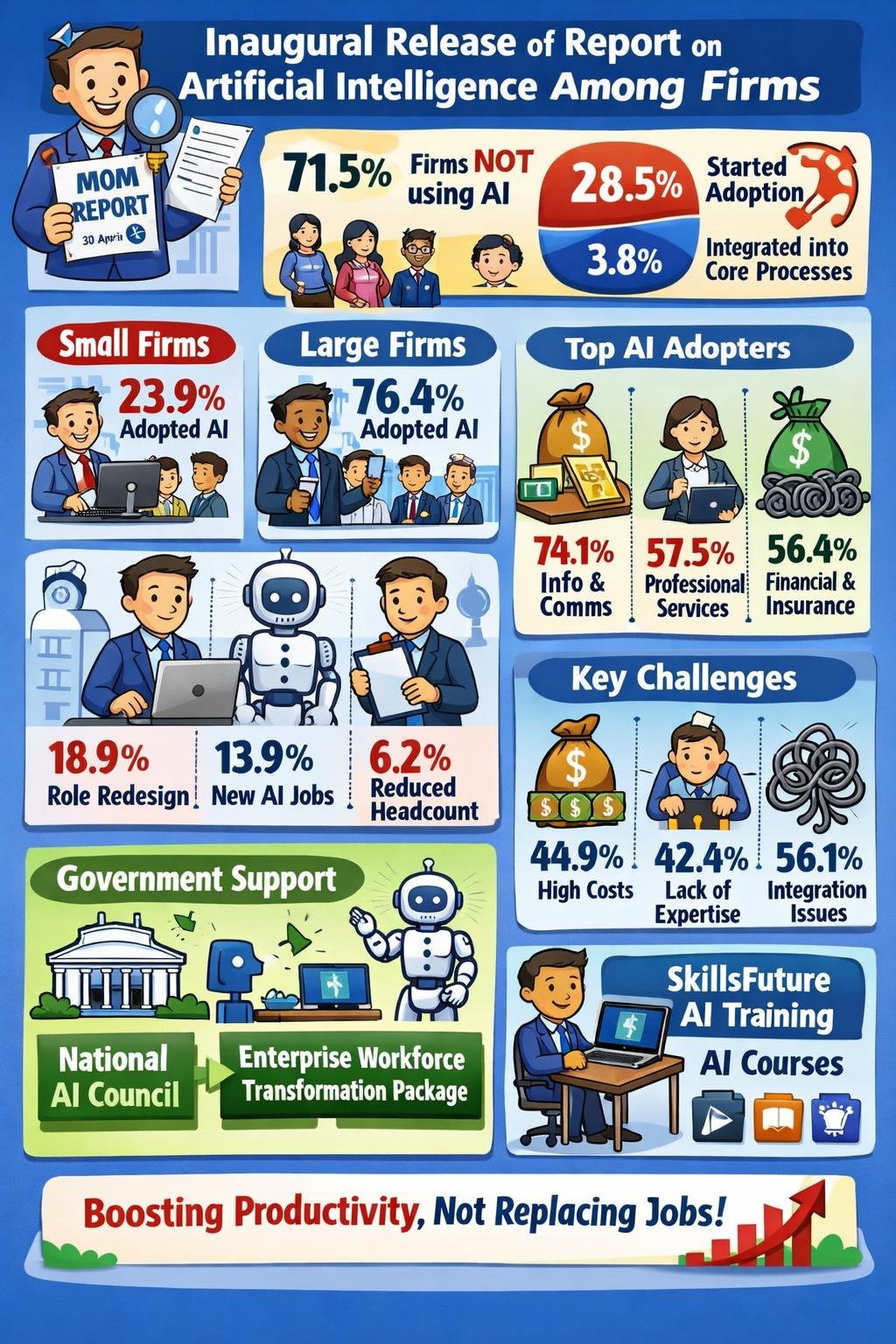
Overall, a majority of firms have not yet adopted AI. Among the 71.5% of firms that haven't started, only 28.5% have begun to integrate AI. Of those who have started, meaningful integration remains limited: just 3.8% are integrating AI into core business processes, while most are still at the planning (7.4%) or piloting (6.0%) stages.
Adoption rates vary significantly by company size. Firms with fewer than 25 employees show an adoption rate of 23.9%, compared to 76.4% among larger firms. Larger companies also demonstrate deeper integration, reflecting their stronger digital capabilities and resources.
Certain sectors are more advanced in AI adoption. Information and Communications leads at 74.1%, followed by Professional Services (57.5%) and Financial and Insurance Services (56.4%). These industries feature roles with higher shares of tasks that can be automated or augmented by AI, such as software development, systems analysis, and data analytics. The digitally fluent PMET workforce in these sectors is well-positioned to work alongside AI tools effectively.
The report finds that AI is augmenting rather than replacing labour. There is no indication of widespread job displacement so far; only 6.2% of firms reported reduced headcount after adopting AI. Instead, firms are redesigning roles (18.9%) and creating new AI-related jobs (13.9%), indicating that AI is primarily transforming tasks rather than replacing entire roles.
Productivity gains are already evident among firms using AI. 70.7% report improvements in worker productivity, alongside gains in decision-making (13.3%) and innovation (11.9%).
However, structural barriers continue to constrain uptake. High implementation costs (44.9%) and lack of in-house expertise (42.4%) are the most commonly cited constraints. Smaller firms face additional challenges such as lack of strategy (32.4%) and low trust in AI (30.8%), while larger firms struggle with integration complexity (56.1%) and data security concerns (55.4%).
Firms are beginning to build capabilities for AI adoption and support workforce adaptation. Smaller AI-adopting firms are focused on foundational steps such as training (46.6% of AI-adopting firms) and provision of AI tools such as ChatGPT, DeepSeek and IBM Cognos Analytics (41.1%). Larger firms are moving towards governance frameworks (37.5%) and workflow redesign (22.5%). Workforce adjustments are taking place mainly within firms rather than across sectors.
The report concludes that AI is reshaping work and creating opportunities to improve productivity, but the key challenge is whether firms and workers can keep pace: smaller firms risk falling further behind on adoption, while workers who do not upskill risk being left behind as AI transforms our day-to-day tasks.
To support this transition, the Government has established the National AI Council (NAIC) to coordinate and drive Singapore's AI strategy. The NAIC will oversee the development and execution of AI missions in key sectors of our economy, namely advanced manufacturing, connectivity, finance and healthcare. To support AI adoption, firms can tap on the recently launched Enterprise Workforce Transformation Package (EWTP) to undertake job redesign, reskilling and building the organisational capabilities needed to translate AI adoption into better workforce outcomes.
SkillsFuture Singapore (SSG) will introduce simple self-diagnostic tools to help workers assess their AI-readiness and identify suitable courses suited to their needs. The Government will also be providing six months of complimentary access to premium versions of AI tools for Singaporeans who take up selected AI courses. Workers can tap on these to build up their AI proficiency.
- MOM released its first report on AI adoption among firms on 30 April 2026
- % of firms have not yet adopted AI; only 3.8% integrate AI into core processes
- AI adoption is higher in larger firms (76.4%) than smaller ones (23.9%)
- Information and Communications, Professional Services, and Financial sectors lead in AI adoption
- No widespread job displacement yet; only 6.2% of firms reduced headcount after adopting AI
- % of AI-using firms report productivity gains, with improvements in decision-making and innovation
- Main barriers are high costs (44.9%) and lack of expertise (42.4%)
- Government supports adoption via National AI Council, Enterprise Workforce Transformation Package (EWTP), and SkillsFuture diagnostic tools
Publisher: Ministry of Manpower
Editorial note: First-of-its-kind data on AI adoption provides actionable insights for workers planning upskilling or career moves.