MAS Monetary Policy Statement - April 2026
MAS raises the Singapore dollar slightly to guard against rising global energy costs and inflation. Expect higher transport bills and adjusted spending power.
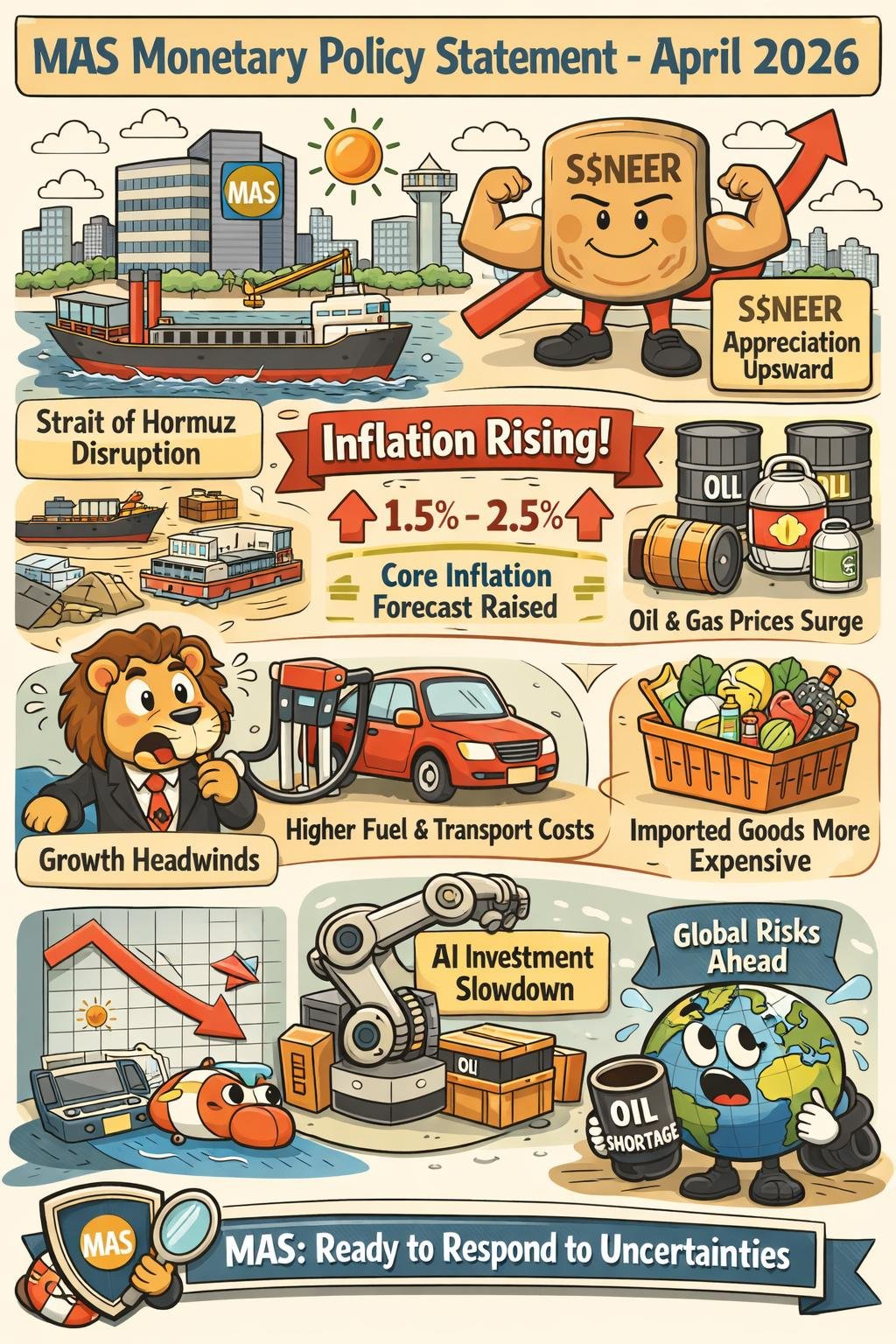
In its April 2026 Monetary Policy Statement, the Monetary Authority of Singapore (MAS) announced a slight increase in the rate of appreciation of the Singapore dollar nominal effective exchange rate (S$NEER) policy band. The width of the band and its centred level remain unchanged.
The decision comes against a backdrop of significant global economic uncertainty. Since late-February, shipping through the Strait of Hormuz has been severely constrained, causing worldwide prices for crude oil, natural gas, and related chemicals to rise sharply. Asia is facing physical shortages and higher import prices. MAS Core Inflation held steady at 1.2% year-on-year in January–February 2026, but forecasts have been revised upwards.
Economic growth in Singapore's major trading partners is expected to be weaker than previously anticipated due to drags on industrial production and expenditure. While some advanced markets remain resilient and global AI-related investment continues, the accumulated energy supply shortfalls and higher input costs will weigh on the outlook. Energy-dependent industries like petrochemicals and transport will face pressure.
Advance estimates from the Ministry of Trade and Industry (MTI) show the economy expanded at 4.6% year-on-year in Q1 2026, underpinned by manufacturing and services tied to the global AI capex cycle. However, GDP declined by 0.3% quarter-on-quarter seasonally-adjusted in Q1 2026 following a 1.3% expansion in the preceding quarter.
MAS has raised its forecasts for MAS Core Inflation and CPI-All Items inflation to 1.5–2.5%, up from the previous 1.0–2.0%. Private transport inflation is expected to be higher due to fuel price hikes, though this may be offset by subdued accommodation inflation amid weaker housing rental growth.
The situation in the Middle East remains highly uncertain. MAS warns that a more persistent disruption to energy supplies would exacerbate inflationary pressures and deepen the drag on growth. Shortages of key intermediate inputs could abruptly curtail industrial production. A further tightening in global financial conditions or unexpected pullback in AI-related investment could compound downside risks.
Consequently, MAS will increase slightly the rate of appreciation of the S$NEER policy band to guard against imported inflation and maintain price stability.
- MAS increased the rate of appreciation of the Singapore dollar nominal effective exchange rate (S$NEER) policy band slightly in April 2026
- The width and centred level of the S$NEER policy band remain unchanged
- Global energy prices have risen sharply due to shipping constraints through the Strait of Hormuz since late-February 2026
- MAS Core Inflation forecasts raised to 1.5–2.5% from 1.0–2.0% for the year ahead
- CPI-All Items inflation forecast also raised to 1.5–2.5% from 1.0–2.0%
- Private transport inflation expected to rise due to higher fuel prices; accommodation inflation subdued due to weaker rental growth
- Economy expanded 4.6% year-on-year in Q1 2026, but GDP declined 0.3% quarter-on-quarter seasonally-adjusted
- MAS will continue to monitor economic developments and is ready to curb excessive volatility in the S$NEER
Publisher: MAS
Editorial note: Central bank policy directly impacts household purchasing power and daily expenses; remains relevant for all consumers.