Singapore Food Statistics 2025
Singapore Food Statistics 2025 reveals progress in import diversification, local farm productivity gains and improved food safety trends from 2023 to 2025.
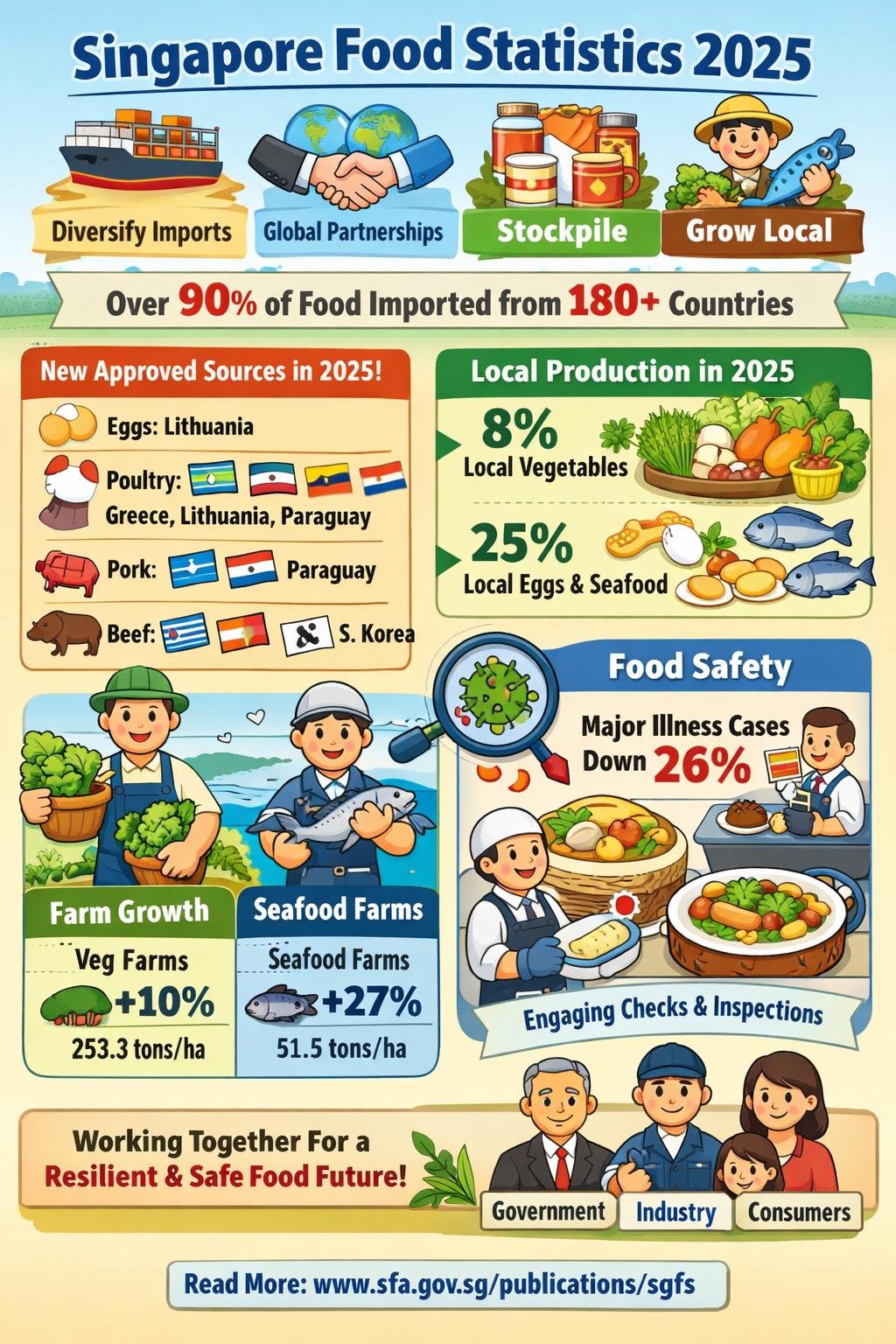
The Singapore Food Agency (SFA) has released the Singapore Food Statistics 2025, an annual report covering food supply and safety data from 2023 to 2025. The publication highlights progress under the refreshed Singapore Food Story 2 strategy, launched in November 2025, which focuses on four pillars: Diversify Imports, Global Partnerships, Stockpile and Grow Local.
Diversifying imports remains critical as Singapore imports over 90 per cent of its food. In 2025, supply sources expanded to more than 180 countries and regions, up from about 140 two decades ago. To ensure safety, SFA requires accreditation at source for higher-risk items like livestock, meat, eggs, poultry, pork, and beef. New approved sources in 2025 included shell eggs from Lithuania; processed eggs from Brazil, Lithuania and Paraguay; poultry from Greece, Lithuania and Paraguay; pork from Greece and Paraguay; and beef from Greece, Paraguay and Republic of Korea.
Local production aims to supply 20 per cent of fibre and 30 per cent of protein consumed locally by 2035. As of 2025, local farms contributed about eight per cent of local fibre (fresh leafy and fruited vegetables, beansprouts, mushrooms) and 25 per cent of local protein (eggs and seafood). From 2024 to 2025, vegetable farm productivity rose by about 10 per cent (from 231.4 to 253.3 tonnes per hectare), while seafood farm productivity increased by about 27 per cent (from 40.7 to 51.5 tonnes per hectare). Egg production and productivity declined slightly due to temporary operational challenges at some farms, which are localised and not systemic.
SFA supports farm growth through initiatives like the Agri-food Cluster Transformation Fund 2, National Broodstock Centre and Hatchery Development and Recognition Programme, and supply-demand aggregation via the Singapore Agro-Food Enterprises Federation.
Food safety remains a cornerstone. SFA uses a science-based risk management framework with data-driven inspections, testing, surveillance and horizon scanning. Major foodborne illness outbreak cases (affecting 15 or more persons) dropped from 22.8 to 16.8 per 100,000 population from 2024 to 2025. There were fewer confirmed foodborne illness cases in catering-related incidents compared with 2024. SFA stepped up targeted checks on establishments supplying catered food and engaged industry associations to share outbreak insights and remind operators on good practices.
Building a resilient, safe food supply is a joint responsibility for the Government, industry and consumers. The full Singapore Food Statistics 2025 publication is available at www.sfa.gov.sg/publications/sgfs.
- SFA published Singapore Food Statistics 2025 covering food supply and safety data from 2023 to 2025
- Singapore now sources food from over 180 countries and regions in 2025, up from about 140 two decades ago
- New import sources approved in 2025 include shell eggs (Lithuania), processed eggs (Brazil, Lithuania, Paraguay), poultry (Greece, Lithuania, Paraguay), pork (Greece, Paraguay) and beef (Greece, Parag
- Local farms aim to supply 20% of fibre and 30% of protein by 2035; as of 2025 they contributed about 8% of local fibre and 25% of local protein
- Vegetable farm productivity rose 10% from 2024 to 2025 (231.4 to 253.3 tonnes per hectare); seafood farm productivity rose 27% (40.7 to 51.5 tonnes per hectare)
- Major foodborne illness outbreak cases dropped from 22.8 to 16.8 per 100,000 population from 2024 to 2025
- SFA stepped up targeted checks on catering establishments after fewer foodborne illness cases were reported in catering incidents compared with 2024
- Full report available for download at www.sfa.gov.sg/publications/sgfs
Publisher: Singapore Food Agency
Editorial note: Provides ongoing insight into national food resilience strategy, supply chain diversification and safety metrics that remain relevant for consumers.